MCQs
i) Atoms react with each other because:
- A. they are attracted to each other
- B. they are short of electrons
- C. they want to attain stability
- D. they want to disperse
i) Atoms react with each other because:
- A. they are attracted to each other
- B. they are short of electrons
- C. they want to attain stability
- D. they want to disperse
iii) Considering the electronic configuration of atoms which atom with the given atomic number will be the most stable one?
- A. 6
- B. 8
- C. 10
- D. 12
iv) Octet rule is:
- A. description of eight electrons
- B. picture of the electronic configuration
- C. pattern of the electronic configuration
- D. attaining eight electrons
v) Transfer of electrons between atoms results in:
- A. metallic bonding
- B. ionic bonding
- C. covalent bonding
- D. coordinate covalent bonding
vi) When an electronegative element combines with an electropositive element the type of bonding is:
- A. covalent
- B. ionic
- C. polar covalent
- D. coordinate covalent
vii) A bond formed between two non-metals is expected to be:
- A. covalent
- B. ionic
- C. coordinate covalent
- D. metallic
viii) A bond pair in covalent molecules usually has:
- A. one electron
- B. two electrons
- C. three electrons
- D. four electrons
ix) Which of the following compounds is not directional in its bonding?
- A. CH4
- B. KBr
- C. C02
- (d) H20
x) Ice floats on water because:
- A. ice is denser than water
- B. ice is crystalline in nature
- C. water is denser than ice
- D. water molecules move randomly
Read more: Periodic Table and Periodicity of Properties
Short Questions Chemsitrty Notes bise Rawalpindi Structure of Molecules cha 4
Q.1 Why do atoms react?
Answer:
All atoms, except for the noble gasses, are unstable because their outermost shell is not full. They achieve stability by attaining the electronic configuration of inert gasses. Atoms react with other atoms to gain or lose electron(s) to fill their outermost shell.
Q.2 Why is the bond between an electropositive and an electronegative atom ionic in nature?
Answer:
The electronegative atom has a strong tendency to gain an electron and the electropositive atom has a tendency to give up an electron easily. So the two types will form ions, the electronegative atom forms anion, and the electropositive atom forms cation.
These oppositely charged ions are attracted to one another to form a bond. Therefore, the bond formed is ionic in nature. For example, sodium is an electropositive element and loses an electron. Chlorine is an electronegative element and gains an electron. Therefore, they form positive and negative ions and combine with each other.
Na → Na+ + e–
Cl + e– → Cl–
Na+ + Cl– → NaCl
Q.3 Ionic compounds are solids. Justify.
Answer:
Ionic compounds are made when positively and negatively charged ions form an ionic bond. These ions are held together by a strong electrostatic attractive force. The oppositely charged ions pack tightly with each other such that the movement of the ions is ceased and they form a crystal lattice structure.
Q.4 More electronegative elements can form bonds between themselves. Justify.
Answer:
Electronegative elements have the tendency to gain as well as share electrons. So they can easily share their electrons between themselves to form bonds. For example, oxygen molecules form through covalent bonding between two oxygen atoms.

Q.5 Metals are good conductors of electricity. Why?
Answer:
The outermost electrons in atoms of metals are delocalized i.e. they are held by weak atomic forces, allowing these electrons to move freely from one atom to another. Metals have a strong shielding effect which makes the removal of outermost electrons easy. When an electric field is applied to a metal, the mobile valence electrons act as the current carrier. Thus, metals act as good conductors of electricity.
Q.6 Ionic compounds conduct electricity in solution or molten form. Why?
Answer:
In ionic compounds the ions are tightly packed with each other such that the movement of the ions is restricted and they cannot move freely. So these ions cannot conduct electric current. However, in molten state the charge carriers are free to move and act as current carriers. Thus, molten forms of ionic compounds conduct electricity.
Q.7 What type of covalent bond is formed in a nitrogen molecule?
Answer:
Nitrogen atom belongs to Group 15 and has 5 electrons in its valence shell. It needs 3 electrons to complete its shell. Two nitrogen atoms share their 3 electrons with each other. Thus three bond pairs are involved in bond formation. This type of bond is called triple covalent bond.

Q.8 Differentiate between lone pair and bond pair of electrons.
Answer:

Q.9 Describe at least two necessary conditions for the formation of a covalent bond.
Answer:
(i) Electronegativity difference between the bonding atoms must be less than 1.7. If the electronegativity difference is more than 1.7, the bond is ionic.
(ii) Each of the two combining atoms should have 5, 6 or 7 electrons in their valence shells. In such cases, both the atoms achieve the stable octet by sharing 3, 2 or 1 electron pairs respectively.
Read more: Structure of Atoms Class
Q.10 Why HCl has dipole-dipole forces of attraction?
Answer:
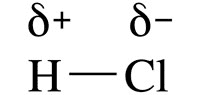
Chlorine is more electronegative than hydrogen. Therefore, chlorine in HCl attracts the shared pair of electrons towards itself with greater force. As a result a partial negative charge is created on chlorine and a partial positive charge on hydrogen.
The oppositely charged atoms of adjacent molecules come near each other. It results in a net force of attraction between them in adjacent molecules. Thus HCl has dipole-dipole forces of attraction.

Q.11 What is a triple covalent bond, explain with an example?
Answer:
When each atom shares three electrons, the bond is called triple covalent bond. For example two nitrogen atoms share their 3 electrons with each other. Thus three bond pairs are involved in bond formation.

Q.12 What is the difference between polar and nonpolar covalent bonds, explained with one example of each?
Answer:
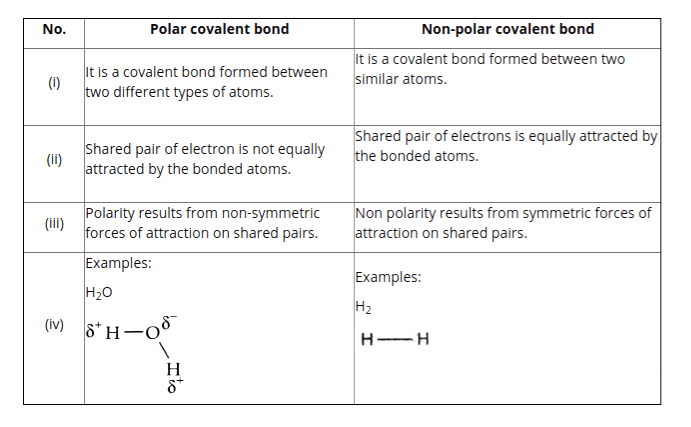
Q.13 Why does a covalent bond become polar?
Answer:
If the bonded atoms have more electronegativity difference, the shared pair of electrons is attracted strongly towards the more electronegative atom than the less electronegative one. Thus, there will be an unequal attraction for the bonded pair. As a result, opposite poles develop and the covalent bond becomes polar. For example, the bond between hydrogen and chlorine is polar in nature.
Q.14 What is the relationship between electronegativity and polarity?
Answer:
Electronegativity is the ability of an atom to attract the shared pair of electrons towards itself. A big difference between electronegativity causes a partial positive charge on one atom, and a partial negative charge on the other, which is polarity. Greater is the electronegativity difference between the bonded atoms, more is the polarity.
For example in HF a partial negative charge is created on fluorine and a partial positive charge on hydrogen due to a big electronegativity difference between them.

Q.15 Why does ice float on water?
Answer:
In liquid state the water molecules move randomly. When water is cooled, hydrogen bonding takes place. The molecules form an ordered crystal that spaces the molecules farther apart than when they were in a liquid. As a result ice becomes less dense than water and floats on water.
Q.16 Give the characteristic properties of ionic compounds.
Answer:
Characteristic properties of ionic compounds
(i) Ionic compounds form crystals.
(ii) Ionic compounds have high melting points and high boiling points.
(iii) Solid ionic compounds are insulators but conduct electricity when they are in molten state or dissolved in water.
(iv) Ionic compounds are soluble in water and in many polar solvents.
(v) Ionic compounds are hard.
Read more: Fundamentals of Chemistry
Q.17 What characteristic properties do the covalent compounds have?
Answer:
Characteristic properties of covalent compounds
(i) Covalent compounds are soft and relatively flexible.
(ii) Covalent compounds usually have low melting points and boiling points.
(iii) Many covalent compounds do not dissolve well in water.
(iv) Covalent compounds are nonelectrolytes.
Long Questions
Q.1 What is an ionic bond? Discuss the formation of ionic bond between sodium and chlorine atoms?
Answer:
Ionic bond
It is a chemical bond that is formed due to complete transfer of valence electron(s) between atoms and that generates two oppositely charged ions.
Formation of NaCl
Sodium belongs to group 1 and has 1 electron in its valence shell. Chlorine belongs to group 17 and has 7 electrons in its valence shell. The ground state electronic configuration of both elements is as below:
11Na = 1s2, 2s2, 2p6, 3s1
17Cl = 1s2, 2s2, 2p6, 3s2, 3p5
Sodium has 1 electron more than a stable noble gas structure. It gives away that electron to become more stable. Chlorine has 1 electron short of a stable noble gas structure. It gains an electron from sodium to become more stable. Therefore, they form positive and negative ions by losing and gaining electrons and attain the electronic configuration to the nearest noble gas:
Na → Na+ + e–
1s2, 2s2, 2p6
Cl + e– → Cl–
1s2, 2s2, 2p6, 3s2, 3p6
Sodium becomes Na+ and chlorine becomes Cl–. The resulting oppositely charged ions are attracted to one another and draw closer. They combine with each other due to electrostatic attractions between them.
Na+ + Cl– → NaCl
Q.2 How can you justify that bond strength in polar covalent compounds is comparable to that of ionic compounds?
Answer:
Ionic bonding is a complete transfer of electrons from one atom to another atom forming charged ions. The atom that loses electrons becomes positively charged and the atom that gains electrons becomes negatively charged. These opposite charges are held together by electrostatic force of attraction between them.
Na → Na+ + e–
Cl + e– → Cl–
Na+ + Cl– → NaCl
Covalent bonding is the sharing of electrons between two atoms. Sometimes, these electrons are not equally shared. If one of the bonding atoms is more electronegative, it will attract the bond pair of electrons more strongly than the other one. Thus there will be unequal attraction of the electrons for the shared pair of electrons. A partial negative charge is therefore created on the more electronegative atom and a partial positive charge is created on the less electronegative atom.
Q.4 How a covalent bond develops ionic character in it? Explain.
Answer:
When two atoms of different elements share electrons to form a covalent bond, the shared electrons are not attracted evenly by the two nuclei of bonding atoms. The more electronegative atom attracts the bond pair of electrons strongly than the other one. Due to unequal distribution of electrons, a partial negative charge is created on the more electronegative atom and a partial positive charge is created on the less electronegative atom. The polarity of bond gives partial ionic character.
In the hydrogen fluoride (HF) molecule, fluorine is more electronegative and attracts the shared pair of electrons towards itself strongly. Therefore, F atom acquires a partial negative charge, and H atom a partial positive charge. This causes the covalent bond between H and F to have an appreciable ionic character.
Q.6 How a coordinate covalent bond is formed? Explain with examples?
Answer:
A coordinate covalent bond or dative covalent bond is formed when shared pair of electrons comes from only one atom from the two atoms involved in the bonding. The atom which donates the electron pair is called the donor atom, while the atom which accepts the electron pair is called the acceptor atom. A coordinate covalent bond is represented by an arrow. This arrow indicates the atom and pair of electrons being donated. It starts from the donor atom and ends in the acceptor atom.
Examples:
(i) Formation of ammonium ion
Ammonium ion is formed by the combination of ammonia molecule (NH3) and a hydrogen ion (H+). Nitrogen has a lone pair of electrons. It donates this lone pair to the hydrogen ion and ammonium ion (NH4+) is formed. Thus the nitrogen atom acts as a donor and hydrogen ion acts as an acceptor.
Q.8 Define hydrogen bonding. Explain that how these forces affect the physical properties of compounds.
Answer:
Hydrogen bonding
Hydrogen bonding is the electrostatic attraction present between polar molecules. It occurs when a hydrogen atom bound to a highly electronegative atom, having lone pairs of electrons, experiences attraction by some other nearby highly electronegative atom such as nitrogen, oxygen and fluorine.
So, it is a type of intermolecular force between the partially positively charged hydrogen atom of one molecule and partially negatively charged atom of another molecule. This force of attraction is represented by a dotted line between the molecules as shown below:
Effect of hydrogen bonding
(i) on boiling point
Molecules exhibiting hydrogen bonding have higher boiling points. For example, boiling point of water (100oC) is higher than that of alcohol (78oC). This is because water has greater intermolecular forces, hydrogen bonding.
(ii) on viscosity
Hydrogen bonding results in strong forces between the molecules. These molecules tend to stick next to one another and are less likely to flow. Therefore, substances which exhibit hydrogen bonding have a higher viscosity than those that do not.
Q.9 What are intermolecular forces? Compare these forces with chemical bond forces with reference to HCl molecule?
Answer:
Intermolecular forces
Atoms within a molecule are attracted towards each other by chemical bonds. These are called intramolecular forces. In addition to these strong forces, the weak electrostatic forces of attraction between the molecules are called intermolecular forces.
The chemical bond forces and intermolecular forces of molecule HCl is as follows:
Chlorine is more electronegative than hydrogen. Therefore, chlorine in HCl attracts the shared pair of electron towards itself with greater force. As a result a partial negative charge is created on chlorine and a partial positive charge on hydrogen. As a result opposite poles develop and the covalent bond becomes polar. The oppositely charged atoms of adjacent molecules come near to each other. It results in a net force of attraction between them in adjacent molecules.
Intermolecular forces are weaker than the intramolecular or chemical bond forces. 17kJ energy is required to break the intermolecular forces between hydrogen chloride molecules in one mole of it. And 430kJ energy is required to break the chemical bond between hydrogen and chlorine atoms in one of hydrogen chloride.
Q.10 What is a chemical bond and why do atoms form a chemical bond?
Answer:
Chemical bond
Chemical bond is the force of attraction which holds two or more atoms or ions in a molecule. Everything around us is composed of matter which is made up of atoms. These atoms combine with each other to form different molecules which appear in different states of matter. Chemical bond is the force responsible for building the atoms into molecules or compounds.
All atoms, except for the noble gases, are unstable because their outermost shell is not full. They stabilize themselves by losing or gaining electron(s) to attain a maximum of eight electrons in their valence shell giving them the same electron configuration as a noble gas. Therefore, atoms form chemical bonds with other atoms to gain or lose electrons to fill their outermost shell and become stable.
The simplest chemical bond is that formed between two hydrogen atoms. Each hydrogen atom has one electron. Two hydrogen atoms, each contributing one electron, share a pair of electrons. In the resulting molecule, both atoms have two electrons and a filled outermost shell and are stable.


