Perfect24u
  • Home
  • KPK
    • KPK TEXTBOOK
      • Grade 1 KPK Textbook (KPK)
      • Grade 2 KPK Textbook Board
      • Grade 3 KPTBB
      • Grade 4 KPTBB
      • Grade 5 KPTBB
      • Grade 6 KPTBB
      • Grade 7 KPTBB
      • Grade 8 KPTBB
      • Grade 9 KPTBB
      • Grade 10 KPTBB Textbook
      • Grade 12 books for KPK
      • Grade 11 BOOK KPK Board
    • Class 4 Notes KPK
    • Class 5 KPK Notes
    • Class 6 Notes (kpk)
    • Class 7 KPK Notes
    • Class 8 KPK Notes
    • Class 9 KPK Notes
      • Mathematics
      • English Class 9 Notes for KPK
      • 9th Urdu Notes
      • Biology 9th
      • Islamiat 9
      • Computer Science 9th
      • Pak Studies 9
      • Physics 9th
      • Chemistry 9th
    • Class 10 KPK Notes
      • Mutalae Quran -e- Hakeem 10th
      • Bio Class 10 Notes KPK
      • Physics Class 10 Notes KPK
      • English 10th Notes
      • CHEMISTRY 10 NOTES
      • class 10 Maths
      • Iskamic Education Grade 10 KPK
      • General Mathematics Grade X kpk
      • Pak Study 10th
      • Urdu 10
    • Class 11 KPK Notes
      • Urdu Notes Grade XI, 1st Year for KPK
      • Islamic Education Notes KPK
      • Biology Notes 1st Year Kpk
      • 1st Year Kpk Mutale Quran Notes
      • Islamic Education Notes KPK
      • 1st Year computer Science KPK Notes
      • 1st Year Mathematics Notes
      • BISEP ICS G11
      • chemistry class 11 notes
      • English FA Fsc Part 1 KPK
      • Islamiat Class 11 for kpk
      • Physics class 11 notes
    • 2nd Years KPK Notes
      • 2nd Year Chemistry Notes
      • Bio Class 12 KPK Notes
      • Urdu Class 12 KPK Notes
      • Mathematics-XII
      • 2nd year computer science notes
      • 2nd Year Economics Notes
      • 2nd year English notes
      • 2nd year Pakistan Study Notes
      • 2nd Year Physics Notes
    • BISE Swat
      • Model Papers
      • Chemistry Class 10 Notes
      • Class 11 Computer Science
      • Economics Notes Class 11
      • Statistics Class 11
      • Class 12 Statistics Notes
    • Syllabus
    • Mardan Board
      • 9th Notes
    • Shams Notes
      • Class 9 Shams Notes, Guide
      • Class 10 Shams Notes
  • AIOU
    • B.ED books
    • M.ED
    • M.PHIL
    • B.S AIOU Books
    • M.SC
    • MBA
    • Matric Aiou
    • Bachelor AIOU Books
    • CT AIOU Books
    • M.SC
    • M.PHIL
    • FA
    • M.COM
    • P.HD
    • MPA EXECUTIVE
    • B.S AIOU Books
    • MSC. ADMINISTRATIVE SCIENCES
    • M.A Aiou Soft Books
      • M.A (LIB.SCI)
      • MA HISTORY
      • M.A (E.P.M)
      • MA SPECIAL EDUCATION
      • M.A (TEFL/ DIP)
      • MA ARABIC
      • M.A (EDU)
      • M.A Islamic Study
      • MA (URDU)
  • BISE Lahore
    • Class X
      • English Class 10th Notes
    • Class IX
      • English Class 9th Notes
    • Class XI
      • English Class 11th Notes
    • Class XII
      • English Class 12th Notes
  • Sindh Board
    • Sindh Textbook Jamshoro
      • STBB CLASS 1 BOOKS
      • STBB CLASS 2 BOOKS
      • STBB CLASS 3 BOOKS
      • STBB CLASS 4 BOOKS
      • STBB CLASS 5 BOOKS
      • STBB CLASS 6 BOOKS
      • STBB CLASS 7 BOOKS
      • STBB CLASS 8 BOOKS
      • STBB CLASS 9 BOOKS
      • STBB CLASS 10 BOOKS
      • STBB CLASS 12 BOOKS
    • Class 5 Notes All Subjects Sindh Board
      • Science Notes Class 5 Sindh
      • English Notes Class 5 sindh
      • Sindhi Class 5
      • Urdu Notes Grade V Sindh
      • Pak Study Notes Grade V Sindh
    • 6th Class Notes, Guide Sindh Board
      • Islamia Notes, Grade VI, 6th Sindh
      • Mathematics Notes Class 6th sindh
      • Sindhi Medium Class 6th
      • Urdu 6th Class Sindh
      • Social Studies Grade vi notes
      • G Science Guide Notes sindh Grade Six
      • English Grade 6 Notes Sindh
    • 7th Class Notes Sindh Board
      • Islamiat G VII Sindh
      • Urdu Grade VII Sindh
      • English 7 Class Notes Sindh
      • Arabic Notes Grade VII Sindh
      • Sindhi Grade VII
      • G Science 7 Class Sindh Notes
      • Social Studies Notes Grade VII Sindh
      • Mathematics Grade VII Sindh
    • Class 8th Notes for Sindh Board
      • Islamiat Notes Grade VIII Sindh
      • Arabic Notes Grade VIII Sindh
      • Urdu Grade VIII Notes Sindh
      • G Science Grade VIII Sindh Notes
      • English Class 8th Notes Sindh
      • General Science Grade 8th Sindh
      • Mathematics Grade VIII Notes Sindh
      • Sindhi Notes Grade VIII
    • Class IX
      • Pak Studies Sindh 9
      • Urdu Sindh class 9 notes
      • Class 9 Sindh General Mathematics Notes
      • Grade IX, Class 9th Civics Notes
      • Economic Grade ix
      • Computer Science 9 Sindh
      • Mathematic Sindh Class 9
      • Chemistry Notes
      • Biology 9
      • Physics
      • Islamic Educations Notes Gade IX Sindh
      • Sindh Board English 9th Notes
      • Islamiat Class 9 Sindh
      • Sindhi Class 9 Notes
    • Class X
      • Pak Studies Grade X, Class 10th Notes Sindh Board
      • Mathematics Grade X, 10th Notes Sindh Notes
      • Civics Notes UM Grade X, Class 10th Karachi Sindh
      • Economics C10, Grade X Sindh Board Notes
      • Islamic Education Notes Grade X Sindh Board
      • Urdu Notes Class 10 Sindh Board
      • Chemistry Grade X, Class 10th, SSc Part-2 Sindh Board
      • General Mathematics C10 Sindh
      • Economics C10, Grade X Sindh Board Notes
      • Civics Notes UM Grade X, Class 10th Karachi Sindh
      • Biology C10th Class, Grade X Notes for Sindh Board
      • Sindh Class 10 Physics
      • Sindh Class 10th English Notes
      • Islamiat Class 10 Sindh
      • MODEL QUESTION PAPERS BISE Sindh Karachi
    • Class XI
      • Urud Class 11 Sindh Notes
      • BIOLOGY SINDH 1ST YEAR
      • PHYSICS Sindh Board G11
      • Maths G11 BIEK
      • Islamic Education Notes
      • Chemistry Class 11 Notes Sindh
      • Islamiat
      • English notes class 11 Sindh board
    • Class XII
      • English Notes Sindh board 12th
      • Urdu Notes 2nd Year Sindh
      • Pak study 2nd Year Sindh Board
      • Biology F.Sc. Part-II 2nd Years Sindh Board
      • 2nd Year Chemistry Notes Sindh Board Pdf
      • Mathematics Class 12 Sindh
      • Grade 12 Sindh Physics
  • CBSE
    • CBSE Class 9
    • CBSE Class 10
    • CBSE Class 11
    • CBSE Class 12
  • Rawalpindi
    • Class 9th
      • Chemistry G9
      • Mathematics G9
      • Pak Studies G9
      • G9 Urdu
      • English 9th Notes
      • Biology G9
      • Physics G9
    • Class 10th
      • English 10th Notes
    • Class 11th
      • English 11th Notes
  • FBISE
    • Text Books (Federal)
    • 9 Class
      • Chemistry Class IX
      • Biology Notes
      • Physics IX
      • 9th FBISE Maths
      • Islamiat EM FBISE
      • FBISE PAK STUDY 9
      • Computer Science
      • FBISE URDU CLASS IX
      • Fbise 9 Notes Eng
    • 10 Class Federal Board Notes
      • Computer Grade X (Fbise) Notes
      • Islamiat Notes 10th (Fbise)
      • Pak Studies (Fbise) Notes Grade X
      • Physics Notes Grade X (Fbise)
      • Fbise Grade X Maths Notes
      • English FBISE Notes
      • BIOLOGY X
      • Chemistry (fbise) Notes Grade X
    • 11 Class
      • FBISE English 11th
      • Physics Notes 1st Year Fbise
      • Biology 1st Year Fbise
      • Islamiat Notes 1st Year Fbise
      • Math Notes 1st Year Fbise
      • Urdu 1st Year Fbise Notes
      • Chemistry Fbise Notes Grade XI
      • Computer Science
    • 12 Class
      • Class 12 English Notes Fbise
      • Business Statistics Grade XII Notes (Fbise)
      • Fbise Class XII Pakistan Studies Notes
      • Computer Sci Notes for Fbise 2nd Years
      • Fsc Chemistry 2nd Years (fbise) Notes
      • Urdu Notes Grade XII (Fbise)
      • Grade XII Mathematics Fbise Notes
      • Biology Notes (fbise) 2nd Years
      • Physics Notes (Fbise) 2nd Years
    • FBISE Past Papers
      • 10 Class Federal Board Notes
      • 9th Past Papers
  • Articles
    • Essay
    • Admissions
    • Happy Teacher Day
    • Insurance
    • Islamic
    • Speeches
    • Story
    • DIT
    • DAE
    • MCQs
  • Punjab
    • PTBB All Class Books Pdf
      • Class 5 PCTB Textbook All Subjects
      • Class 6 PCTB All Books in Pdf
      • Grade VII All Books PCTB
      • Class 8 All Book PCTB
      • Class 9 Punjab Board Textbook
      • Grade X, Class 10 Matric Textbook for Pctb
      • Class 11 Textbooks Punjab Board
      • 2nd Years PCTB All Subjects
    • Class 11 Notes PTBB
      • Computer Science PTBB Class 11
      • English 11 Notes Punjab
      • Chemsitry PTBB 11th
      • Math Notes PTBB 11th
      • Physics PTBB 11th
      • Urdu PTBB 11th
      • Biology 11th PTBB
    • Class 9 Punjab Board Notes All Subjects (PCTB)
    • Class 10th All Subjects Notes Punjab Board
    • Punjab Board Class 10 Chemistry
    • Class 12 Punjab Notes All Subjects
  • Novels
    • Islamic Based Novels
    • Urdu Novels
    • Romantic Novels
    • Areej Shah Novels
    • Umera Ahmed
    • Rude Hero Based
    • Love Story Based
    • Suspenseful Novel
    • forced marriage novels
    • Zeenia Sharjeel Novels
    • Tera Ashiq May Diwana
    • junoon e ulfat
    • Motivational Based Novels
    • Village Based
    • Innocent Heroine Based
    • Revenge Based Novels
    • Second Marriage Based
    • Digest
    • Strong Heroin Based
  • KIPS BOOKS PDF
  • Islamia Notes
    • CLASS 10 ISLAMIA NOTES
    • 2nd Years IAN
  • NAYAB NOTES
    • 1st Year Nayab Notes
    • 2nd YEARS Nayab Guide
  • Shams Notes
    • Class 10 Shams Notes
    • Class 9 Shams Notes, Guide
No Result
View All Result
  • Home
  • KPK
    • KPK TEXTBOOK
      • Grade 1 KPK Textbook (KPK)
      • Grade 2 KPK Textbook Board
      • Grade 3 KPTBB
      • Grade 4 KPTBB
      • Grade 5 KPTBB
      • Grade 6 KPTBB
      • Grade 7 KPTBB
      • Grade 8 KPTBB
      • Grade 9 KPTBB
      • Grade 10 KPTBB Textbook
      • Grade 12 books for KPK
      • Grade 11 BOOK KPK Board
    • Class 4 Notes KPK
    • Class 5 KPK Notes
    • Class 6 Notes (kpk)
    • Class 7 KPK Notes
    • Class 8 KPK Notes
    • Class 9 KPK Notes
      • Mathematics
      • English Class 9 Notes for KPK
      • 9th Urdu Notes
      • Biology 9th
      • Islamiat 9
      • Computer Science 9th
      • Pak Studies 9
      • Physics 9th
      • Chemistry 9th
    • Class 10 KPK Notes
      • Mutalae Quran -e- Hakeem 10th
      • Bio Class 10 Notes KPK
      • Physics Class 10 Notes KPK
      • English 10th Notes
      • CHEMISTRY 10 NOTES
      • class 10 Maths
      • Iskamic Education Grade 10 KPK
      • General Mathematics Grade X kpk
      • Pak Study 10th
      • Urdu 10
    • Class 11 KPK Notes
      • Urdu Notes Grade XI, 1st Year for KPK
      • Islamic Education Notes KPK
      • Biology Notes 1st Year Kpk
      • 1st Year Kpk Mutale Quran Notes
      • Islamic Education Notes KPK
      • 1st Year computer Science KPK Notes
      • 1st Year Mathematics Notes
      • BISEP ICS G11
      • chemistry class 11 notes
      • English FA Fsc Part 1 KPK
      • Islamiat Class 11 for kpk
      • Physics class 11 notes
    • 2nd Years KPK Notes
      • 2nd Year Chemistry Notes
      • Bio Class 12 KPK Notes
      • Urdu Class 12 KPK Notes
      • Mathematics-XII
      • 2nd year computer science notes
      • 2nd Year Economics Notes
      • 2nd year English notes
      • 2nd year Pakistan Study Notes
      • 2nd Year Physics Notes
    • BISE Swat
      • Model Papers
      • Chemistry Class 10 Notes
      • Class 11 Computer Science
      • Economics Notes Class 11
      • Statistics Class 11
      • Class 12 Statistics Notes
    • Syllabus
    • Mardan Board
      • 9th Notes
    • Shams Notes
      • Class 9 Shams Notes, Guide
      • Class 10 Shams Notes
  • AIOU
    • B.ED books
    • M.ED
    • M.PHIL
    • B.S AIOU Books
    • M.SC
    • MBA
    • Matric Aiou
    • Bachelor AIOU Books
    • CT AIOU Books
    • M.SC
    • M.PHIL
    • FA
    • M.COM
    • P.HD
    • MPA EXECUTIVE
    • B.S AIOU Books
    • MSC. ADMINISTRATIVE SCIENCES
    • M.A Aiou Soft Books
      • M.A (LIB.SCI)
      • MA HISTORY
      • M.A (E.P.M)
      • MA SPECIAL EDUCATION
      • M.A (TEFL/ DIP)
      • MA ARABIC
      • M.A (EDU)
      • M.A Islamic Study
      • MA (URDU)
  • BISE Lahore
    • Class X
      • English Class 10th Notes
    • Class IX
      • English Class 9th Notes
    • Class XI
      • English Class 11th Notes
    • Class XII
      • English Class 12th Notes
  • Sindh Board
    • Sindh Textbook Jamshoro
      • STBB CLASS 1 BOOKS
      • STBB CLASS 2 BOOKS
      • STBB CLASS 3 BOOKS
      • STBB CLASS 4 BOOKS
      • STBB CLASS 5 BOOKS
      • STBB CLASS 6 BOOKS
      • STBB CLASS 7 BOOKS
      • STBB CLASS 8 BOOKS
      • STBB CLASS 9 BOOKS
      • STBB CLASS 10 BOOKS
      • STBB CLASS 12 BOOKS
    • Class 5 Notes All Subjects Sindh Board
      • Science Notes Class 5 Sindh
      • English Notes Class 5 sindh
      • Sindhi Class 5
      • Urdu Notes Grade V Sindh
      • Pak Study Notes Grade V Sindh
    • 6th Class Notes, Guide Sindh Board
      • Islamia Notes, Grade VI, 6th Sindh
      • Mathematics Notes Class 6th sindh
      • Sindhi Medium Class 6th
      • Urdu 6th Class Sindh
      • Social Studies Grade vi notes
      • G Science Guide Notes sindh Grade Six
      • English Grade 6 Notes Sindh
    • 7th Class Notes Sindh Board
      • Islamiat G VII Sindh
      • Urdu Grade VII Sindh
      • English 7 Class Notes Sindh
      • Arabic Notes Grade VII Sindh
      • Sindhi Grade VII
      • G Science 7 Class Sindh Notes
      • Social Studies Notes Grade VII Sindh
      • Mathematics Grade VII Sindh
    • Class 8th Notes for Sindh Board
      • Islamiat Notes Grade VIII Sindh
      • Arabic Notes Grade VIII Sindh
      • Urdu Grade VIII Notes Sindh
      • G Science Grade VIII Sindh Notes
      • English Class 8th Notes Sindh
      • General Science Grade 8th Sindh
      • Mathematics Grade VIII Notes Sindh
      • Sindhi Notes Grade VIII
    • Class IX
      • Pak Studies Sindh 9
      • Urdu Sindh class 9 notes
      • Class 9 Sindh General Mathematics Notes
      • Grade IX, Class 9th Civics Notes
      • Economic Grade ix
      • Computer Science 9 Sindh
      • Mathematic Sindh Class 9
      • Chemistry Notes
      • Biology 9
      • Physics
      • Islamic Educations Notes Gade IX Sindh
      • Sindh Board English 9th Notes
      • Islamiat Class 9 Sindh
      • Sindhi Class 9 Notes
    • Class X
      • Pak Studies Grade X, Class 10th Notes Sindh Board
      • Mathematics Grade X, 10th Notes Sindh Notes
      • Civics Notes UM Grade X, Class 10th Karachi Sindh
      • Economics C10, Grade X Sindh Board Notes
      • Islamic Education Notes Grade X Sindh Board
      • Urdu Notes Class 10 Sindh Board
      • Chemistry Grade X, Class 10th, SSc Part-2 Sindh Board
      • General Mathematics C10 Sindh
      • Economics C10, Grade X Sindh Board Notes
      • Civics Notes UM Grade X, Class 10th Karachi Sindh
      • Biology C10th Class, Grade X Notes for Sindh Board
      • Sindh Class 10 Physics
      • Sindh Class 10th English Notes
      • Islamiat Class 10 Sindh
      • MODEL QUESTION PAPERS BISE Sindh Karachi
    • Class XI
      • Urud Class 11 Sindh Notes
      • BIOLOGY SINDH 1ST YEAR
      • PHYSICS Sindh Board G11
      • Maths G11 BIEK
      • Islamic Education Notes
      • Chemistry Class 11 Notes Sindh
      • Islamiat
      • English notes class 11 Sindh board
    • Class XII
      • English Notes Sindh board 12th
      • Urdu Notes 2nd Year Sindh
      • Pak study 2nd Year Sindh Board
      • Biology F.Sc. Part-II 2nd Years Sindh Board
      • 2nd Year Chemistry Notes Sindh Board Pdf
      • Mathematics Class 12 Sindh
      • Grade 12 Sindh Physics
  • CBSE
    • CBSE Class 9
    • CBSE Class 10
    • CBSE Class 11
    • CBSE Class 12
  • Rawalpindi
    • Class 9th
      • Chemistry G9
      • Mathematics G9
      • Pak Studies G9
      • G9 Urdu
      • English 9th Notes
      • Biology G9
      • Physics G9
    • Class 10th
      • English 10th Notes
    • Class 11th
      • English 11th Notes
  • FBISE
    • Text Books (Federal)
    • 9 Class
      • Chemistry Class IX
      • Biology Notes
      • Physics IX
      • 9th FBISE Maths
      • Islamiat EM FBISE
      • FBISE PAK STUDY 9
      • Computer Science
      • FBISE URDU CLASS IX
      • Fbise 9 Notes Eng
    • 10 Class Federal Board Notes
      • Computer Grade X (Fbise) Notes
      • Islamiat Notes 10th (Fbise)
      • Pak Studies (Fbise) Notes Grade X
      • Physics Notes Grade X (Fbise)
      • Fbise Grade X Maths Notes
      • English FBISE Notes
      • BIOLOGY X
      • Chemistry (fbise) Notes Grade X
    • 11 Class
      • FBISE English 11th
      • Physics Notes 1st Year Fbise
      • Biology 1st Year Fbise
      • Islamiat Notes 1st Year Fbise
      • Math Notes 1st Year Fbise
      • Urdu 1st Year Fbise Notes
      • Chemistry Fbise Notes Grade XI
      • Computer Science
    • 12 Class
      • Class 12 English Notes Fbise
      • Business Statistics Grade XII Notes (Fbise)
      • Fbise Class XII Pakistan Studies Notes
      • Computer Sci Notes for Fbise 2nd Years
      • Fsc Chemistry 2nd Years (fbise) Notes
      • Urdu Notes Grade XII (Fbise)
      • Grade XII Mathematics Fbise Notes
      • Biology Notes (fbise) 2nd Years
      • Physics Notes (Fbise) 2nd Years
    • FBISE Past Papers
      • 10 Class Federal Board Notes
      • 9th Past Papers
  • Articles
    • Essay
    • Admissions
    • Happy Teacher Day
    • Insurance
    • Islamic
    • Speeches
    • Story
    • DIT
    • DAE
    • MCQs
  • Punjab
    • PTBB All Class Books Pdf
      • Class 5 PCTB Textbook All Subjects
      • Class 6 PCTB All Books in Pdf
      • Grade VII All Books PCTB
      • Class 8 All Book PCTB
      • Class 9 Punjab Board Textbook
      • Grade X, Class 10 Matric Textbook for Pctb
      • Class 11 Textbooks Punjab Board
      • 2nd Years PCTB All Subjects
    • Class 11 Notes PTBB
      • Computer Science PTBB Class 11
      • English 11 Notes Punjab
      • Chemsitry PTBB 11th
      • Math Notes PTBB 11th
      • Physics PTBB 11th
      • Urdu PTBB 11th
      • Biology 11th PTBB
    • Class 9 Punjab Board Notes All Subjects (PCTB)
    • Class 10th All Subjects Notes Punjab Board
    • Punjab Board Class 10 Chemistry
    • Class 12 Punjab Notes All Subjects
  • Novels
    • Islamic Based Novels
    • Urdu Novels
    • Romantic Novels
    • Areej Shah Novels
    • Umera Ahmed
    • Rude Hero Based
    • Love Story Based
    • Suspenseful Novel
    • forced marriage novels
    • Zeenia Sharjeel Novels
    • Tera Ashiq May Diwana
    • junoon e ulfat
    • Motivational Based Novels
    • Village Based
    • Innocent Heroine Based
    • Revenge Based Novels
    • Second Marriage Based
    • Digest
    • Strong Heroin Based
  • KIPS BOOKS PDF
  • Islamia Notes
    • CLASS 10 ISLAMIA NOTES
    • 2nd Years IAN
  • NAYAB NOTES
    • 1st Year Nayab Notes
    • 2nd YEARS Nayab Guide
  • Shams Notes
    • Class 10 Shams Notes
    • Class 9 Shams Notes, Guide
No Result
View All Result
Perfect24u
No Result
View All Result
Home Rawalpindi Board Class 9th Chemistry G9

Bise Rawalpindi G9 Electrochemistry Chemistry Notes Cha 7

20k
SHARES
20k
VIEWS
Share on WhatsApp FacebookShare on Twitter

Matric Part-1 Chemistry Notes Chapter number 7 Electrochemistry short questions, and long questions.

Q.1) Define oxidation in terms of electrons. Give an example.

Answer:

Oxidation is the loss of electron(s) by an atom or an ion.

Examples:

Lithium loses an electron to form a positive charge.

Li → Li+1 + e–

Ferrous loses an electron to form ferric

Fe+2 → Fe+3 + e–

Q.2) Define reduction in terms of loss or gain of oxygen or hydrogen. Give an example.

Answer:

Reduction is the addition of hydrogen or loss of oxygen.

Examples:

N2 molecule gains hydrogen and forms NH3.

N2 + 3H2 → 2NH3

CuO loses oxygen and forms Cu.

Zn + CuO → Zn + CuO

Q.3) What is the difference between valency and oxidation state?

Answer: 

ValencyOxidation state
Valency is the measure of an element’s ability to combine with other elements. It is determined by the number of electrons in the outermost shell of each atom of an element.Oxidation state is a number assigned to an element in a chemical combination. It represents the number of electrons that an atom can gain, lose, or share.
The number precedes the sign while writing the valency.The sign precedes the number while writing the oxidation state.
Example:Valency of nitrogen = N3+Example:Oxidation state of nitrogen in HNO3 = N+5

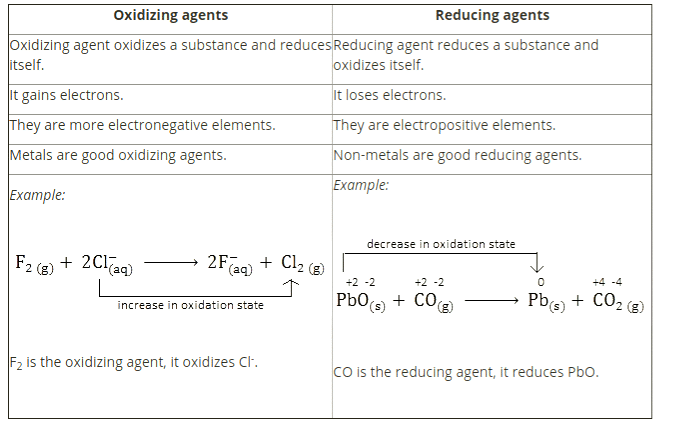
Q.4) Differentiate between oxidizing and reducing agents

Answer:
q 9kOfKU4ugW0vL6mYzbLla19CH6XVpmtAu8znH9ZZXW0ODgzRmG0CDn8GSmHm8Cd3ONWNmn61mwRzlolpe7HuqfkUkmKqjez95UBvdFv6ZM79fYi2vTsJb3dDTcoGs7gONHD1lkM1buY2w2zw Perfect Notes 24U

Q.5) Differentiate between strong and weak electrolytes.

Answer:

Strong electrolytesWeak electrolytes
Strong electrolytes almost completely dissociate in their aqueous solutions and produce more ions.Weak electrolytes only partially dissociate in solution and produce relatively few ions.
Examples:Aqueous solutions of NaCl, NaOH, HBr, H2SO4 etcNaCl → Na+ + Cl–Examples:CH3COOH, NH3, HF dissolved in water.CH3COOH + H2O → CH3COO– + H3O+

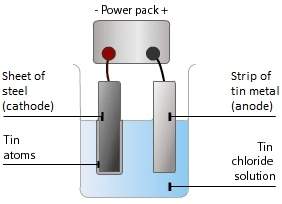
Q.6) How is the electroplating of tin on steel carried out?

Answer:

A clean sheet of steel is dipped into a container of a solution of tin salt. The steel acts as the cathode and another electrode made of tin acts as anode. An electric current is passed through the circuit and tin metal ions present in the solution deposit on steel.
vuGyy0Y7UHpfjumjj8ke RAdObcWzQuiqxScpOKzp NxIYOixgT6VtBoUEI rcpZB737m9j2r pt XYL4i frD815jmNy1ruNpy Perfect Notes 24U

Q.7) Why is steel plated with nickel before the electroplating of chromium?

Answer:

Steel is plated with nickel before the electroplating of chromium because it does not adhere well on the surface of steel. Chromium sits best on nickel which itself provides adhesion. Thus, chromium deposited over the layer of nickel lasts longer. Nickel is the source of shine, and resistance to corrosion in the chromium plating.

Q.8) How can you explain that the following reaction is oxidation in terms of increase of oxidation number?

                                                 AI° →Al3+ + 3e–

Answer:

Oxidation is loss of electrons. Oxidation state increases during oxidation. Aluminum loses three electrons and acquires +3 oxidation state. The oxidation state has increased from 0 to +3. Thus the reaction is an oxidation reaction.

Q.9) How can you prove with an example that conversion of an ion to an atom is an oxidation process?

Answer:

Oxidation is the loss of electrons. Anions undergo oxidation to convert to an atom. For example, chlorine ion (anion) loses electrons and converts into a chlorine molecule.

2Cl– → Cl2 + 2e–

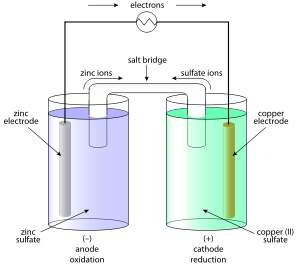
Q.10) Why does the anode carry a negative charge in galvanic cells but a positive charge in electrolytic cells? Justify with comments.

Answer:

The anode is defined as the electrode where oxidation takes place. In a galvanic cell Zn is anode, Zn atoms lose electrons and give Zn+2 ions to solution. Since electrons are always present on the Zn plate, it is negative.
6goIzxwnbxEFUAT12WHY9rMDvBqUcCB6N2B aZFKJWiAGZkiDZH3bFJMX7nTnrEqa9erUyvdDfQvAZMJSzqmazG7XKF1zFMse92xOovYUGpkjhnwjcw3HZ0CRIA1 rRsqeQ6gnDqIK8QFg t4g Perfect Notes 24U

In an electrolytic cell, anions migrate from the solution towards the anode. And anions are negatively charged, so anode is positive.

XqFRvdLldp6RzqeH89NGnESG6vf Nu0osytGaAC9lQuJ2joWu cDLgdO qyzBnetw5rBPpaVGgtxtqkNS54FB7H68o3fRX4iAdXq8evWvJ KiP KmiH4c92TlWSe83 mkYicOqBp2fp1yasVVA Perfect Notes 24U

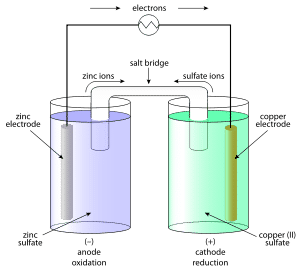
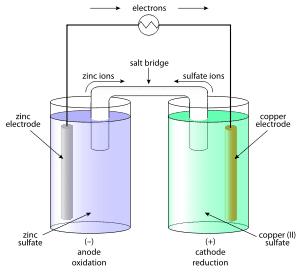
Q.11) Where do the electrons flow from the Zn electrode in Daniel’s cell?

Answer:

In Daniel’s cell electrons flow from the Zn electrode (cathode) to the Cu electrode (anode) through an external circuit. Zn metal loses electrons which flow to Cu electrode and are gained by the copper ions of the solution and copper atoms deposit at the electrode.
R6mK0YTePbBpxac3AE2TWzW1 Perfect Notes 24U

Q.12) Why do electrodes get their names ‘anode’ and’ cathode ‘in galvanic cells?

Answer:

The two electrodes in a galvanic cell are Zn electrode and Cu electrode. Zn metal loses electrons i.e. oxidation takes place at Zn electrode. Therefore, it is named anode.

Zn → Zn2+ + 2e–

The electrons lost by Zn metal are gained by copper ions i.e. Cu+2 reduces and Cu atoms are deposited at the electrode. Therefore, it is named cathode.

Cu2+ + 2e– → Cu
MqJ5v694D4O jL9wnEAmOhpRbnHGHNogaPYoeBTFWvRMvBOPXU aARH1TbsMjR agMIGdO7CuLm0EokdK 251473nH5GCeOQWNcvE 29mnGYsHQiBX7szmwzV6YgNQzffu8DbMX0Z027j4FBNQ Perfect Notes 24U

Q.13) What happens at the cathode in a galvanic cell?

Answer:

Reduction takes place at cathode in a galvanic cell.

                                                    Cu2+ + 2e– → Cu

See also  Structure of Atoms Class 9 Cha 2 Bise Rawalpindi Notes

The electrons lost by Zn metal are gained by copper ions of the solution i.e. Cu+2 reduces and Cu atoms are deposited at the electrode.

Q.14) Which solution is used as an electrolyte in Nelson’s cell?

Answer:

Concentrated solution of sodium chloride called brine is used as an electrolyte in Nelson’s cell.

Q.15) Name the by-products produced in Nelson’s cell?

Answer:

Nelson’s cell is used for manufacturing of caustic soda (NaOH) from brine solution on industrial scale. Hydrogen gas (H2) and chlorine gas (Cl2) are the by-products produced.

                                    2NaCl + 2H2O → H2 + Cl2 + 2NaOH

Q.16) Why is galvanizing done?

Answer:

Galvanizing is done to protect iron (Fe) against corrosion. It is done by coating a thin layer of zinc (Zn) on iron.

Q.17) Why is an iron grill painted frequently?

Answer:

Action of moist air with the iron causes it to rust. Iron grill is painted frequently to prevent it from rusting, weathering and other atmospheric effects.

Q.18) Why is O2 necessary for rusting?

Answer:

Stains and dents on the iron surface provide the site for rusting. This region is called anodic region. Iron dissolves in water to give Fe+2 and release electrons as follows:

Fe → Fe+2 + 2e–

The electrons liberated from the anode portion of the iron flow to the cathode. Cathode is the region with relatively high concentration of O2 near the surface surrounded by water. The free oxygen and dissolved iron bond into the salt Fe2O3.nH2O, which is called rust.

2Fe+2 + ½ O2 + (2+n)H2O →  Fe2O3.nH2O + 4H+

This shows that O2 is necessary for rusting.

Q.19) In electroplating of chromium, which salt is used as an electrolyte?

Answer:

An aqueous solution of chromium sulfate containing a little sulphuric acid acts as an electrolyte in electroplating of chromium.

Q.20) Write the redox reaction taking place during the electroplating of chromium?

Answer:

An aqueous solution of chromium sulfate containing a little sulphuric acid acts as an electrolyte in electroplating of chromium.

Electrolyte ionizes as follows:

Is3fxBBh97w17yZsoUtaz18EKmvGsgnUUxT3bij4Sj7n6mpxMS6NXADxUMomOGwYYbFmReBld7688QV6AH6kt6ti4aiwNPsp0ICUrFDMU6tJiDUvRn4vrz0umHfzAl2cdbpWjre kuJgR88pjA Perfect Notes 24U

Cr3+ ions migrate towards the cathode. At cathode they discharge and deposit on the object to be electroplated.

Reaction at anode:

4OH- → 2H2O + O2 + 4e– 

At cathode:

Cr3+ + 3e– → Cr

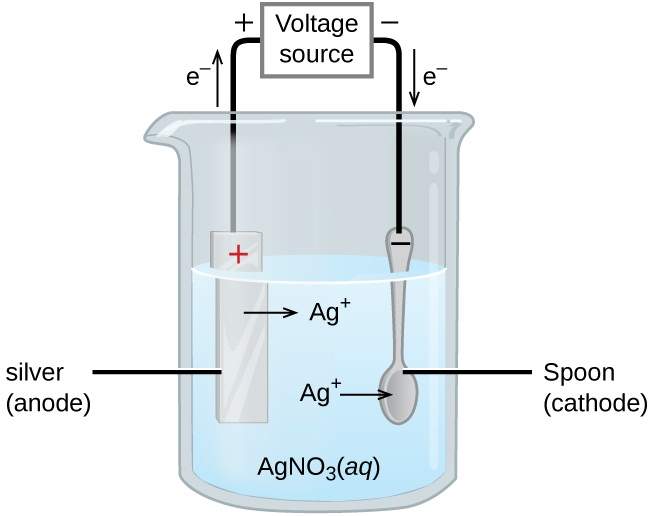
Q.21) In electroplating of silver, from where Ag+ ions come and where do they deposit?

Answer:

In electroplating of silver, a pure piece of silver strip acts as anode and a metallic object to be coated such as a spoon acts as cathode. These electrodes are dipped in silver nitrate solution. On passing the electric current, anode dissolves to produce Ag+ ions. These ions migrate towards the cathode, where they are discharged and deposited on the object.

At anode:

Ag → Ag+ + e–

At cathode:

Ag+ + e– → Ag
QpWP mBt3s3rpb7jEwnsnGtbY23MgAMm8CB4b gAYrqv2CPtYsTqmshGHkS2K nw5ukNeI9RSKR5MHt1dBs Perfect Notes 24U

Q.22) What is the nature of electrodes used in electroplating of chromium?

Answer:

In electroplating of chromium, anode is made of antimonial-lead and the cathode is made of the object to be electroplated.

Long Questions

Q.1) Describe the rules for assigning the oxidation state.

Answer:

Rules for assigning oxidation state

 i) The oxidation number of all elements in their free (uncombined) state is zero.

ii) The oxidation number of a monatomic ion is the same as the charge on the ion.

iii) The oxidation number of: Group 1 element is +1, Group 2 element is +2, Group 13 element is +3. Group 15, Group 16 and Group 17 elements have oxidation states of -3, -2 and -1 respectively.

iv) Hydrogen (H) has two possible oxidation numbers. +1 when it is bonded to a nonmetal and -1 when it is bonded to a metal.

v) The oxidation number of oxygen in a compound is usually –2. But it is -1 in peroxides and +2 in OF2.

vi) The sum of the oxidation numbers in a neutral compound is equal to 0.

vii) The more electronegative atom in a substance has the negative oxidation number.

viii) The sum of the oxidation numbers in a polyatomic ion is equal to the charge of the ion.

Q.2) Find out the oxidation numbers of the underlined elements in the following compounds.

a) Na2SO4           

b) AgNO3            

c) KMnO4    

d) K2Cr2O7     

e) HNO2

Answer:

a) Na2SO4

The sum of the oxidation number is zero.

2 (Oxidation no. of Na) + Oxidation no. of S + 4 (Oxidation no. of O) = 0

2 (+1) + Oxidation no. of S + 4 (-2) = 0

+2 + Oxidation no. of S -8 = 0

Oxidation no. of S -6 = 0

Oxidation no. of S = +6

b) AgNO3

The sum of the oxidation number is zero.

Oxidation no. of Ag + Oxidation no. of N + 3 (Oxidation no. of O) = 0

+1 + Oxidation no. of N + 3 (-2) = 0

+1 + Oxidation no. of N -6 = 0

Oxidation no. of N -5 = 0

Oxidation no. of N = +5

c) KMnO4

The sum of the oxidation number is zero.

See also  Fundamentals of Chemistry Bise Rawalpindi Cha 1

Oxidation no. of K + Oxidation no. of Mn + 4 (Oxidation no. of O) = 0

+1 + Oxidation no. of Mn + 4 (-2) = 0

+1 + Oxidation no. of Mn -8 = 0

Oxidation no. of Mn -7 = 0

Oxidation no. of Mn = +7

d) K2Cr2O7

The sum of the oxidation number is zero.

2 (Oxidation no. of K) + 2 (Oxidation no. of Cr) + 7 (Oxidation no. of O) = 0

2 (+1) + 2 (Oxidation no. of Cr) + 7 (-2) = 0

+2 + 2 (Oxidation no. of Cr) -14 = 0

2 (Oxidation no. of Cr) -12 = 0

2 (Oxidation no. of Cr) = +12

Oxidation state of Cr = +12/2 = +6

e) HNO2

The sum of the oxidation number is zero.

Oxidation no. of H + Oxidation no. of N + 2 (Oxidation no. of O) = 0

+1 + Oxidation no. of N + 2 (-2) = 0

+1 + Oxidation no. of N -4 = 0

Oxidation no. of N -3 = 0

Oxidation no. of N = +3

Q.3) How can a non-spontaneous reaction be carried out in an electrolytic cell? Discuss in detail.

Answer:

An electrolytic cell is a type of electrochemical cell that undergoes a non-spontaneous chemical reaction when electrical energy is applied. It is often used to decompose chemical compounds by the process called electrolysis.

An electrolytic cell consists of two electrodes (cathode and anode) dipped in an electrolytic solution. A source of direct current is connected to the pair of inert electrodes. The electrode connected to the negative terminal is called cathode while the electrode connected to the positive terminal is called anode.

When electric current is applied, an electrolytic reaction takes place. The negative ions migrate towards the anode and release electrons as they oxidize. When positive ions collide with the cathode, these ions pick up electrons and as a result reduction takes place.

For example when fused salt of NaCl is electrolyzed, the Cl– ions move towards the anode and release electrons and form chlorine atoms. The chlorine atoms combine together to form chlorine gas which bubbles away.

At anode

2Cl– → Cl2 + 2e–

Na+ ions move towards the cathode and pick up electrons to form sodium metal.

At cathode

2Na+ + 2e– → 2Na

Overall reaction

2Na+ + 2Cl– → 2Na + Cl2

JiXxl 4Om9AmGFn4y3iLUJXORXBwNoRStQxv5SLVtMoiNTn9sWMX0H 2o3nrMOzTMTCnjDOYXKCyxLteWRjQf770fHqRlhNv pi OP R VRQDSCr7SFJcysFZdkfVRdEuLed8NRWAbgIK4Scg Perfect Notes 24U

Q.4) Discuss the electrolysis of water.

Answer:

Electrolysis of water

Electrolysis of water is the decomposition of water (H2O) into oxygen (O2) and hydrogen gas (H2) by passing electric current through water.

Apparatus for electrolysis of water consists of two inert electrodes that are sealed in opposite ends of a container. The electrodes are then connected to a source of electric current.

VWmYm5HrJOVKz0jR8 35ecc576iL3yxcyW7ebDTTTtI5nSyXjFyB7QRWzWuA6c4lGuDLuiHDzLEm83nqo1iJULvEnKjgu1AW3KPBR9HYjwk8DcNCF7h3J AZLBoLJhQA37iB hYX0DObUz9 yQ Perfect Notes 24U

Water by itself is a very poor conductor of electricity. It ionizes to a very small extent. Hydrogen ions (H+) and hydroxyl ions (OH–) are at concentrations of 10-7 mol dm-3. Therefore, few drops of an acid are added to water to provide ions that can flow through the solution. The added acid must be soluble in water and must contain ions that are harder to reduce or oxidize than water.

When electric current is passed through the acidified water, the OH– ions move towards anode, and discharge O2 gas. H+ ions move towards the cathode and discharge H2 gas. The redox reaction taking place is as follows:

At anode (oxidation)

4OH → 2H2O + O2 + 4e–

At cathode (reduction)

4H+ + 4e– → 4H

4H → 2H2

Overall reaction

2H2O → 2H2 + O2

Q.5) Discuss the construction and working of a cell in which electricity is produced.

Answer:

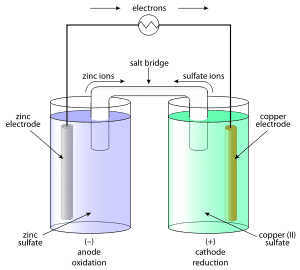
A galvanic cell (also known as a voltaic cell) is an electrochemical cell that uses spontaneous redox reactions to generate electricity.

Construction of galvanic cell

It consists of two separate half-cells. Each half-cell is composed of an electrode dipped in 1 M solution of its own salt and connected to an external circuit through a wire. The two half cells are linked together by a wire running from one electrode to the other. A salt bridge also connects to the half cells.
9ziZYcslR gt0NMVu4UpusbpbGoCHpQjGNMGFSIJtAXuIihOFtQzYFXh4shTpgigt1kbdWnxJjYD5jVPY9zdebIRJL0XtIuP FL193JuYNOL mXJ9z7d v M98Ty2prOh lcq Perfect Notes 24U

One half-cell consists of zinc metal electrodes dipped in 1 M solution of zinc sulfate. The other half-cell consists of copper electrodes dipped in 1 M solution of copper sulfate. The salt bridge maintains the charge neutrality of each half-cell by allowing the ions to flow with minimal mixing of the half-cell solutions.

Working of the cell

Oxidation occurs at the Zn electrode. Zn metal loses electrons which flow through external wire to the copper electrode. Copper ions of the solution pick these electrons to form copper atoms. These atoms deposit at the electrode. The redox reaction taking place is as follows:

Half-cell reaction at anode (oxidation)

Zn → Zn2+ + 2e–

Half-cell reaction at cathode (reduction)

Cu2+ + 2e– → Cu

Overall reaction

Zn + Cu2+ → Zn2+ + Cu

Because of this redox reaction, electric current is produced.

Q.6) How can we prepare NaOH on a commercial scale? Discuss its chemistry along with the diagram.

Answer:

See also  Chemical Reactivity Chemistry Notes Cha 8 fbise Rawalpindi G9

Manufacture of NaOH

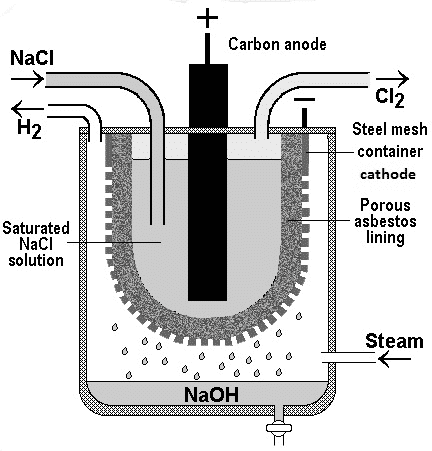
NaOH (caustic soda) is produced on a commercial scale by the electrolysis of aqueous concentrated solution of NaCl called brine. For this purpose a special type of cell called Nelson’s cell is used.

The cell consists of a U-shaped perforated iron vessel, which acts as a cathode. The cathode is coated inside with a diaphragm of asbestos. A carbon rod is suspended inside the U-shaped vessel which acts as anode.
fxsV9Cqh41s0zKW2Th7V3ESbU30 W2nwfkNK10J1WgZffEPpqkq 6ny75v7Eh0Stzwu6fgr2EABSc OGXM 3xmkTozEiSJfRkEhqAKKI ZKOR1eSEic9m5Dsx0w10EGJyuBfzAo61sKoZGla g Perfect Notes 24U

Brine solution is poured into the cell and electric current is passed through it. Aqueous solution of sodium chloride consists of Na+, Cl–, H+ and OH– ions.

Cl– ions move towards anode where they lose electrons and chlorine gas (Cl2) is discharged. Na+ ions move towards the cathode where water splits into hydrogen gas (H2) and OH– ions.

The Na+ ions combine with OH– ions to form NaOH (sodium hydroxide) which is collected in the basin.

At anode (oxidation)

2Cl– → Cl2 + 2e–

At cathode (reduction)

2H+ + 2e– → 2H

2Na+ + 2OH- → 2NaOH

Overall reaction

2NaCl + 2H2O →  H2 + Cl2 + 2NaOH

Q.7) Discuss the redox reaction taking place in the rusting of iron in detail.

Answer:

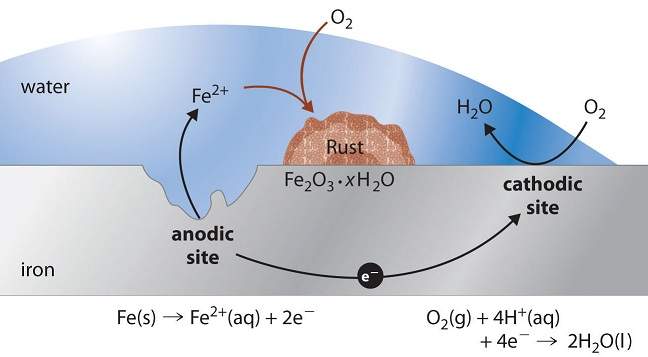
Rust is the name for a very common compound, iron oxide. Stain and dents on the surface of iron provide the site for the rusting process to occur. It is the anodic region and oxidation takes place there.

2Fe →  Fe+2 + 4e–

The electrons released move through the iron and reach a point where O2 concentration is relatively high near the surface surrounded by a water layer. This region is a cathodic region and reduction takes place there. Oxygen molecules are reduced by the electrons in the presence of H+ ions. The sources of H+ ions are atmospheric moisture and carbon dioxide. Water combined with carbon dioxide to form carbonic acid which gives H+ ions.

O2 + 4H+ + 4e– → 2H2O

The overall redox reaction does not form rust.

2Fe + O2 + 4H+ → 2Fe2+ + 2H2O

The free oxygen and dissolved iron bond into the salt Fe2O3.nH2O, which is called rust.

2Fe+2 + ½ O2 + (2+n)H2O →  Fe2O3.nH2O + 4H+
rBnMXz1Cm fNuUVoidIDPjNQW4H6m4VvQ5pJ9 iXxMyZkzu7RtnfVoqikRLZ70pZLqPNKFArcf9pUCWHJp4ca6opcvaQxHXuugqnv42dQ9vf7 QCzNV sWoFPy0eFkk2lKpChE8rHHsBWa7JXw Perfect Notes 24U

Q.8) Discuss why galvanizing is considered better than that of tin plating.

Answer:

The protective coating of zinc works in a different way than tin plating. Zinc is a more active metal than iron. This means when both of them are exposed, zinc reacts. So the zinc dissolves being sacrificed in the protection of the iron. Therefore, zinc protects the iron against corrosion even after the coating is damaged.

The thin tin coating on the iron is used in the beverage and food cans. The can is unreactive to foods in it, while the more active iron would dissolve in acidic foods. When the less active tin coat is scratched, the large area of the tin encourages corrosion of the iron. So the tin protects the iron from corrosion only as long as they are intact. Thus, galvanizing is considered better than tin plating.

Q.9) What is electroplating? Write down the procedure of electroplating.

Answer:

Electroplating

Electroplating is the process of coating one metal onto another by electrolysis. This process is used most commonly for decorative purposes or to prevent corrosion of a metal.

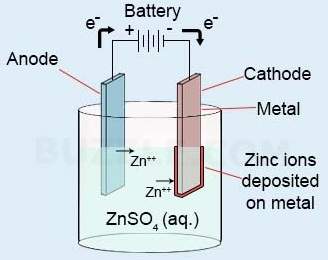
There are also specific types of electroplating such as copper plating, silver plating, and chromium plating. The object to be plated is made cathode (negative electrode) and the metal to be deposited is made anode (positive electrode). The electrolysis is carried out in aqueous solution of a salt of the metal being deposited.

Procedure for electroplating

Generally, one of the electrodes is made from the metal to be plated and the electrolyte is a solution of a salt of the same metal. This electrode is anode.

The electrode on which metal is to deposit is generally made from a cheaper metal or a nonmetal coated with a conducting material such as graphite. This electrode is cathode and is first cleaned with sand, washed with caustic soda solution and finally washed with water. These electrodes are connected with a battery.
e761szWJvE2JWsLqT3JATU9pSjl7FUAy5s5azo7su1zlPNUYFt2tZq4bH67U6Fp8c8hehPEYuSYnsc7I2xpBkxRhz1sKTSjkPsJyu7trhy7X5dawfe3kEEL6Iq2CzwAJ8xw0h3vF8kTn7BG Lg Perfect Notes 24U

When electric current is passed, positive ions (for example Zn ions in the above figure) are attracted to the cathode and slowly deposit on it. As a result, a thin layer of metal deposits on the object, which afterward is pulled out and cleaned.

Q.10) What is the principle of electroplating? How is the electroplating of chromium carried out?

Answer:

Principle of electroplating

The principle of electroplating is to establish an electrolytic cell. The object to be plated is made cathode (negative electrode) and the metal to be deposited is made anode (positive electrode). The electrolysis is carried out in an aqueous solution of a salt of the metal being deposited.

Electroplating of chromium

The object to be electroplated is dipped in an aqueous solution of chromium sulfate. This solution contains sulphuric acid acting as an electrolyte. The object to be plated is made the cathode and the antimonial-lead is made anode. On passing the electric current the electrolyte ionizes and forms Cr3+ ions. These ions move towards the cathode and deposit there.

Ionization of electrolyte

gEXyiki9vLH80RT477b8q3CZV3V0TSDOAZyi hdqnhmSAwbftu7tzL4 byLZhCjmxVuo GIgb1qJhagVyu7fJkHOUTQKlcfo5NKQ 4BAwSkCrXhJuY9ECcpaQU6jhKRU9SHughQMt3IVSm YUA Perfect Notes 24U

At anode

4OH– → 2H2O + O2 + 4e–

At cathode

Cr3+ + 3e– → Cr

The steel first undergoes a copper, then nickel plating prior to the chromium. This is done because chromium does not adhere well to the surface of the steel. Chromium sits best on nickel which itself provides adhesion. Thus chromium deposited lasts longer. Nickel is the source of shine and resistance to corrosion in the chromium plating.

SendShare8000Tweet5000Pin1800Share1400ShareShareShare
Previous Post

HSSC PAPER SCHEME FOR 2022 Sind Board

Next Post

Chemical Reactivity Chemistry Notes Cha 8 fbise Rawalpindi G9

Related Posts

chemistry class 9 chapter 8 solved exercise

Chemical Reactivity Chemistry Notes Cha 8 fbise Rawalpindi G9

April 8, 2024
chemistry chapter 6 notes

Chemistry Cha 6 Solutions Bise Rawalpindi G9

April 8, 2024
Physical States of Matter G9 Bise Rawalpindi

Physical States of Matter G9 Bise Rawalpindi

March 30, 2024
class 9 chemistry

(Structure of Molecules) Bise Rawalpindi Chemistry G9

April 9, 2024
what is periodicity chemistry

Periodic Table and Periodicity of Properties chemistry bise rawalpindi class 9

April 7, 2024
Structure of Atoms Class 9 Cha 2 Bise Rawalpindi Notes

Structure of Atoms Class 9 Cha 2 Bise Rawalpindi Notes

April 7, 2024
Fundamentals of Chemistry Bise Rawalpindi Cha 1

Fundamentals of Chemistry Bise Rawalpindi Cha 1

April 7, 2024

Guest Post Service

Guest Post Service Available contact: fakhrealamin0@gmail.com


  • Home
  • Privacy Policy
  • Contact Us
  • Feedback
  • Disclaimer
  • T&C
  • Cookies Policy
  • Guest Post Service

© 2024 Perfect24u

No Result
View All Result
  • Home
  • KPK
    • KPK TEXTBOOK
      • Grade 1 KPK Textbook (KPK)
      • Grade 2 KPK Textbook Board
      • Grade 3 KPTBB
      • Grade 4 KPTBB
      • Grade 5 KPTBB
      • Grade 6 KPTBB
      • Grade 7 KPTBB
      • Grade 8 KPTBB
      • Grade 9 KPTBB
      • Grade 10 KPTBB Textbook
      • Grade 12 books for KPK
      • Grade 11 BOOK KPK Board
    • Class 4 Notes KPK
    • Class 5 KPK Notes
    • Class 6 Notes (kpk)
    • Class 7 KPK Notes
    • Class 8 KPK Notes
    • Class 9 KPK Notes
      • Mathematics
      • English Class 9 Notes for KPK
      • 9th Urdu Notes
      • Biology 9th
      • Islamiat 9
      • Computer Science 9th
      • Pak Studies 9
      • Physics 9th
      • Chemistry 9th
    • Class 10 KPK Notes
      • Mutalae Quran -e- Hakeem 10th
      • Bio Class 10 Notes KPK
      • Physics Class 10 Notes KPK
      • English 10th Notes
      • CHEMISTRY 10 NOTES
      • class 10 Maths
      • Iskamic Education Grade 10 KPK
      • General Mathematics Grade X kpk
      • Pak Study 10th
      • Urdu 10
    • Class 11 KPK Notes
      • Urdu Notes Grade XI, 1st Year for KPK
      • Islamic Education Notes KPK
      • Biology Notes 1st Year Kpk
      • 1st Year Kpk Mutale Quran Notes
      • Islamic Education Notes KPK
      • 1st Year computer Science KPK Notes
      • 1st Year Mathematics Notes
      • BISEP ICS G11
      • chemistry class 11 notes
      • English FA Fsc Part 1 KPK
      • Islamiat Class 11 for kpk
      • Physics class 11 notes
    • 2nd Years KPK Notes
      • 2nd Year Chemistry Notes
      • Bio Class 12 KPK Notes
      • Urdu Class 12 KPK Notes
      • Mathematics-XII
      • 2nd year computer science notes
      • 2nd Year Economics Notes
      • 2nd year English notes
      • 2nd year Pakistan Study Notes
      • 2nd Year Physics Notes
    • BISE Swat
      • Model Papers
      • Chemistry Class 10 Notes
      • Class 11 Computer Science
      • Economics Notes Class 11
      • Statistics Class 11
      • Class 12 Statistics Notes
    • Syllabus
    • Mardan Board
      • 9th Notes
    • Shams Notes
      • Class 9 Shams Notes, Guide
      • Class 10 Shams Notes
  • AIOU
    • B.ED books
    • M.ED
    • M.PHIL
    • B.S AIOU Books
    • M.SC
    • MBA
    • Matric Aiou
    • Bachelor AIOU Books
    • CT AIOU Books
    • M.SC
    • M.PHIL
    • FA
    • M.COM
    • P.HD
    • MPA EXECUTIVE
    • B.S AIOU Books
    • MSC. ADMINISTRATIVE SCIENCES
    • M.A Aiou Soft Books
      • M.A (LIB.SCI)
      • MA HISTORY
      • M.A (E.P.M)
      • MA SPECIAL EDUCATION
      • M.A (TEFL/ DIP)
      • MA ARABIC
      • M.A (EDU)
      • M.A Islamic Study
      • MA (URDU)
  • BISE Lahore
    • Class X
      • English Class 10th Notes
    • Class IX
      • English Class 9th Notes
    • Class XI
      • English Class 11th Notes
    • Class XII
      • English Class 12th Notes
  • Sindh Board
    • Sindh Textbook Jamshoro
      • STBB CLASS 1 BOOKS
      • STBB CLASS 2 BOOKS
      • STBB CLASS 3 BOOKS
      • STBB CLASS 4 BOOKS
      • STBB CLASS 5 BOOKS
      • STBB CLASS 6 BOOKS
      • STBB CLASS 7 BOOKS
      • STBB CLASS 8 BOOKS
      • STBB CLASS 9 BOOKS
      • STBB CLASS 10 BOOKS
      • STBB CLASS 12 BOOKS
    • Class 5 Notes All Subjects Sindh Board
      • Science Notes Class 5 Sindh
      • English Notes Class 5 sindh
      • Sindhi Class 5
      • Urdu Notes Grade V Sindh
      • Pak Study Notes Grade V Sindh
    • 6th Class Notes, Guide Sindh Board
      • Islamia Notes, Grade VI, 6th Sindh
      • Mathematics Notes Class 6th sindh
      • Sindhi Medium Class 6th
      • Urdu 6th Class Sindh
      • Social Studies Grade vi notes
      • G Science Guide Notes sindh Grade Six
      • English Grade 6 Notes Sindh
    • 7th Class Notes Sindh Board
      • Islamiat G VII Sindh
      • Urdu Grade VII Sindh
      • English 7 Class Notes Sindh
      • Arabic Notes Grade VII Sindh
      • Sindhi Grade VII
      • G Science 7 Class Sindh Notes
      • Social Studies Notes Grade VII Sindh
      • Mathematics Grade VII Sindh
    • Class 8th Notes for Sindh Board
      • Islamiat Notes Grade VIII Sindh
      • Arabic Notes Grade VIII Sindh
      • Urdu Grade VIII Notes Sindh
      • G Science Grade VIII Sindh Notes
      • English Class 8th Notes Sindh
      • General Science Grade 8th Sindh
      • Mathematics Grade VIII Notes Sindh
      • Sindhi Notes Grade VIII
    • Class IX
      • Pak Studies Sindh 9
      • Urdu Sindh class 9 notes
      • Class 9 Sindh General Mathematics Notes
      • Grade IX, Class 9th Civics Notes
      • Economic Grade ix
      • Computer Science 9 Sindh
      • Mathematic Sindh Class 9
      • Chemistry Notes
      • Biology 9
      • Physics
      • Islamic Educations Notes Gade IX Sindh
      • Sindh Board English 9th Notes
      • Islamiat Class 9 Sindh
      • Sindhi Class 9 Notes
    • Class X
      • Pak Studies Grade X, Class 10th Notes Sindh Board
      • Mathematics Grade X, 10th Notes Sindh Notes
      • Civics Notes UM Grade X, Class 10th Karachi Sindh
      • Economics C10, Grade X Sindh Board Notes
      • Islamic Education Notes Grade X Sindh Board
      • Urdu Notes Class 10 Sindh Board
      • Chemistry Grade X, Class 10th, SSc Part-2 Sindh Board
      • General Mathematics C10 Sindh
      • Economics C10, Grade X Sindh Board Notes
      • Civics Notes UM Grade X, Class 10th Karachi Sindh
      • Biology C10th Class, Grade X Notes for Sindh Board
      • Sindh Class 10 Physics
      • Sindh Class 10th English Notes
      • Islamiat Class 10 Sindh
      • MODEL QUESTION PAPERS BISE Sindh Karachi
    • Class XI
      • Urud Class 11 Sindh Notes
      • BIOLOGY SINDH 1ST YEAR
      • PHYSICS Sindh Board G11
      • Maths G11 BIEK
      • Islamic Education Notes
      • Chemistry Class 11 Notes Sindh
      • Islamiat
      • English notes class 11 Sindh board
    • Class XII
      • English Notes Sindh board 12th
      • Urdu Notes 2nd Year Sindh
      • Pak study 2nd Year Sindh Board
      • Biology F.Sc. Part-II 2nd Years Sindh Board
      • 2nd Year Chemistry Notes Sindh Board Pdf
      • Mathematics Class 12 Sindh
      • Grade 12 Sindh Physics
  • CBSE
    • CBSE Class 9
    • CBSE Class 10
    • CBSE Class 11
    • CBSE Class 12
  • Rawalpindi
    • Class 9th
      • Chemistry G9
      • Mathematics G9
      • Pak Studies G9
      • G9 Urdu
      • English 9th Notes
      • Biology G9
      • Physics G9
    • Class 10th
      • English 10th Notes
    • Class 11th
      • English 11th Notes
  • FBISE
    • Text Books (Federal)
    • 9 Class
      • Chemistry Class IX
      • Biology Notes
      • Physics IX
      • 9th FBISE Maths
      • Islamiat EM FBISE
      • FBISE PAK STUDY 9
      • Computer Science
      • FBISE URDU CLASS IX
      • Fbise 9 Notes Eng
    • 10 Class Federal Board Notes
      • Computer Grade X (Fbise) Notes
      • Islamiat Notes 10th (Fbise)
      • Pak Studies (Fbise) Notes Grade X
      • Physics Notes Grade X (Fbise)
      • Fbise Grade X Maths Notes
      • English FBISE Notes
      • BIOLOGY X
      • Chemistry (fbise) Notes Grade X
    • 11 Class
      • FBISE English 11th
      • Physics Notes 1st Year Fbise
      • Biology 1st Year Fbise
      • Islamiat Notes 1st Year Fbise
      • Math Notes 1st Year Fbise
      • Urdu 1st Year Fbise Notes
      • Chemistry Fbise Notes Grade XI
      • Computer Science
    • 12 Class
      • Class 12 English Notes Fbise
      • Business Statistics Grade XII Notes (Fbise)
      • Fbise Class XII Pakistan Studies Notes
      • Computer Sci Notes for Fbise 2nd Years
      • Fsc Chemistry 2nd Years (fbise) Notes
      • Urdu Notes Grade XII (Fbise)
      • Grade XII Mathematics Fbise Notes
      • Biology Notes (fbise) 2nd Years
      • Physics Notes (Fbise) 2nd Years
    • FBISE Past Papers
      • 10 Class Federal Board Notes
      • 9th Past Papers
  • Articles
    • Essay
    • Admissions
    • Happy Teacher Day
    • Insurance
    • Islamic
    • Speeches
    • Story
    • DIT
    • DAE
    • MCQs
  • Punjab
    • PTBB All Class Books Pdf
      • Class 5 PCTB Textbook All Subjects
      • Class 6 PCTB All Books in Pdf
      • Grade VII All Books PCTB
      • Class 8 All Book PCTB
      • Class 9 Punjab Board Textbook
      • Grade X, Class 10 Matric Textbook for Pctb
      • Class 11 Textbooks Punjab Board
      • 2nd Years PCTB All Subjects
    • Class 11 Notes PTBB
      • Computer Science PTBB Class 11
      • English 11 Notes Punjab
      • Chemsitry PTBB 11th
      • Math Notes PTBB 11th
      • Physics PTBB 11th
      • Urdu PTBB 11th
      • Biology 11th PTBB
    • Class 9 Punjab Board Notes All Subjects (PCTB)
    • Class 10th All Subjects Notes Punjab Board
    • Punjab Board Class 10 Chemistry
    • Class 12 Punjab Notes All Subjects
  • Novels
    • Islamic Based Novels
    • Urdu Novels
    • Romantic Novels
    • Areej Shah Novels
    • Umera Ahmed
    • Rude Hero Based
    • Love Story Based
    • Suspenseful Novel
    • forced marriage novels
    • Zeenia Sharjeel Novels
    • Tera Ashiq May Diwana
    • junoon e ulfat
    • Motivational Based Novels
    • Village Based
    • Innocent Heroine Based
    • Revenge Based Novels
    • Second Marriage Based
    • Digest
    • Strong Heroin Based
  • KIPS BOOKS PDF
  • Islamia Notes
    • CLASS 10 ISLAMIA NOTES
    • 2nd Years IAN
  • NAYAB NOTES
    • 1st Year Nayab Notes
    • 2nd YEARS Nayab Guide
  • Shams Notes
    • Class 10 Shams Notes
    • Class 9 Shams Notes, Guide

© 2024 Perfect24u