Chemistry is essential for Chemical Industries, and class 10 Notes for Punjab board can help students get a better understanding of the subject. These notes provide detailed and comprehensive explanations of topics such as stoichiometry, chemical reactions and equations, acids and bases, physical and chemical properties of matter and solutions, and thermochemistry. Additionally, they offer a variety of short and long questions, as well as solved examples, to help students practice and review their knowledge. The notes can also be downloaded in PDF format, making them easily accessible and available for students to use whenever they need them.

Chemical Industries Class 10 Notes Unit 16 in Pdf
Chemical industries are a crucial part of the modern economy, producing a wide range of chemicals used in various applications, from pharmaceuticals to textiles and food processing. The chemistry of these industries is complex, involving a deep understanding of chemical principles and processes. In this article, we will explore the chemistry behind chemical industries and their important role in society.
Chemical industries are involved in the production of various chemicals, including acids, alkalis, solvents, and polymers. The production of these chemicals involves several chemical reactions, each of which requires a specific set of conditions, such as temperature, pressure, and catalysts. For example, the production of sulfuric acid involves the reaction between sulfur trioxide and water, catalyzed by sulfuric acid itself. This reaction requires a temperature of around 340°C and a pressure of 2-3 atmospheres.
The production of chemicals also involves the use of raw materials, such as petroleum, natural gas, and minerals. These raw materials are transformed into usable chemicals through various processes, including distillation, cracking, and oxidation. For example, the production of ethylene, which is used in the production of plastics, involves the cracking of hydrocarbons, such as naphtha or gas oil, at high temperatures and pressures.
Chemical industries also play an important role in sustainability, with a focus on reducing waste and developing more environmentally friendly processes. For example, many chemical companies are exploring the use of renewable raw materials, such as plant-based feedstocks, to reduce their reliance on fossil fuels. Additionally, advances in chemical engineering have led to more efficient and less wasteful production processes, reducing the environmental impact of chemical industries.
In conclusion, chemical industries are an important part of the modern economy, producing a wide range of chemicals used in various applications. The chemistry behind these industries is complex, involving a deep understanding of chemical principles and processes. With a focus on sustainability and innovation, chemical industries will continue to play a crucial role in society, driving technological progress and economic growth.
Q.1) What role is played by pine oil in the froth flotation process?
Answer:
The ore particles are wetted by the pine oil but the gangue particles are not. The oil mixture being lighter is carried to the surface by films of oil. The froth is skimmed off; the gangue settles down on the bottom or remains underneath the froth.
Q.2) Name the various metallurgical operations.
Answer:
The main metallurgical operations are:
(i) Concentration of the ore
(ii) Extraction of the metal
(iii) Refining of the metal
Q.3) How is roasting carried out?
Answer:
Roasting is one of the steps of the processing of ores. In roasting, the oar or ore concentrate is treated with very hot air at a temperature below their melting point. For example, copper pyrite (CuFeS2) is strongly heated in excess of air to convert it into a mixture of cuprous sulphide (Cu2S) and ferrous sulphide (FeS). And the impurities react with oxygen to form volatile oxides.
2CuFeS2 + O2 → Cu2S + 2FeS + SO2
Q.4) Explain the process of electro-refining.
Answer:
Electro-refining
Electro-refining refers to the process of using electrolysis to refine a metal extracted from its ore. In this process, impure metal acts as the anode and a sample of pure metal act as the cathode. For example during the electro-refining stage of copper production, a series of impure copper anodes and thin sheets of pure copper cathodes are suspended in a tank containing acidified copper sulphate solution as electrolyte.
On passing electric current, impure copper dissolves forming Cu2+ ions. These Cu2+ ions gain electrons at the cathode and form Cu atoms, which deposit on the cathode. Thus, pure copper is collected at the cathode.
At anode
Cu → Cu2+ + 2e–
At cathode
Cu2+ + 2e– → Cu
Q.5) What are the advantages of Solvay’s process?
Answer:
Advantages of Solvay process
(i) It is a cheap process. The raw materials are cheap and easily available.
(ii) This process is pollution-free because the only waste is calcium chloride solution.
(iii) Carbon dioxide and ammonia are recovered and reused in the process.
(iv) It produces Na2CO3 of very high purity.
(v) It consumes less fuel since no solution is to be evaporated.
Q.6) What is the principle of Solvay’s process?
Answer:
The principle of Solvay’s process is based on the low solubility of sodium bicarbonate (NaHCO3) at low temperature i.e. at 15oC. Carbon dioxide is passed through ammoniacal brine. The mixture is lowered to 15oC and precipitates of NaHCO3 are obtained.
Na+ + HCO3– → NaHCO3
Q.7) What happens when ammonical brine is carbonated?
Answer:
When ammonical brine is fed into carbonating tower and carbon dioxide is passed through it, the following reactions take place:
CO2 + NH3 + H2O → NH4HCO3
NH4HCO3 + NaCl (brine) → NaHCO3 + NH4Cl
The temperature of the lower compartment is lowered to 15oC and sodium hydrogen carbonate precipitates out.
Q.8) How is NaHCO3 converted to Na2CO3??
Answer:
By heating NaHCO3, it can be converted into Na2CO3.

Q.9) How is ammonia recovered in Solvay’s process?
Answer:
Ammonia is recovered in the recovery tower. Slaked lime (Ca(OH)2) is pumped to this tower and is heated with a solution containing ammonium chloride (NH4Cl) produced in the carbonation tower.
2NH4Cl + Ca(OH)2 → 2NH3 + CaCl2 + 2H2O
Almost all the ammonia is recovered in this process and is reused.
Q.10) How is ammonia prepared for the synthesis of urea?
Answer:
Ammonia is prepared by the Haber process. The Haber process combines 1 volume of nitrogen from the air with 3 volumes of hydrogen derived mainly from natural gas (methane) into ammonia using iron catalyst at 450oC and 200 atm pressure. The reaction is reversible and the production of ammonia is exothermic.

Q.11) Describe the formation of petroleum.
Answer:
It is generally believed that petroleum is formed from the remains of small animals and plants that died hundreds of millions of years ago and fell to the bottom of the sea. Their bodies were covered by sand, rock and mud. Then decomposition took place in the absence of air because of high pressure, temperature and bacterial effects. And the remains started to change into a dark brownish viscous liquid called crude oil or petroleum.
Q.12) What is the refining of petroleum and how is it carried out?
Answer:
Refining petroleum is the conversion of crude oil into useful products such as liquefied petroleum gas (LPG), gasoline or petrol, kerosene, jet fuel, diesel oil and fuel oils. These useful products are called fractions. It is carried out by a process called fractional distillation.
Q.13) Give use of kerosene oil.
Answer:
Kerosene oil is used as a fuel for jet planes and heating.
Q.14) Describe the difference between diesel oil and fuel oil.
Answer:
| Diesel oil | Fuel oil |
| The number of carbon atoms per molecule in diesel oil ranges from 13 to 15. | The,, example of carbon atoms per molecule in fuel oil ranges from 15 to 18. |
| The boiling point ranges from 250 to 350oC. | The boiling point ranges from 350 to 400oC. |
| It is used as fuel in buses, trucks engines, tubewell engines, and other heavy vehicles. | It is used to heat boilers and furnaces in ships and industries. |
Q.15) Write down the names of four fractions obtained by the fractional distillation of residual oil
Answer:
The four fractions obtained by the fractional distillation of residual oil are
(i) asphalt
(ii) lubricants
(iii) paraffin wax
(iv) petroleum coke
Q.16) What is the difference between crude oil and residual oil?
Answer:
| Crude oil | Residual oil |
| Crude oil evaporates on heating up to 400oC for fractional distillation. | Residual oil evaporates on heating above 400oC for further fractional distillation. |
| The fractions of crude oil are petroleum gas, petroleum ether, gasoline, kerosene, diesel oil and fuel oil. | The fractions of residual oil are lubricants, paraffin wax, asphalt and petroleum coke. |
Q.17) Which petroleum fraction is used in dry cleaning?
Answer:
Petroleum ether and gasoline are used for dry cleaning
Long Questions
Q.1) Describe in detail the various processes involved in the concentration of ore. Explain your answer with the help of diagrams.
Answer:
The concentration of the ore
Concentration is the process of removing gangue from the ore. The concentration of the crushed ore is carried out by the following methods:
(a) Gravity separation:
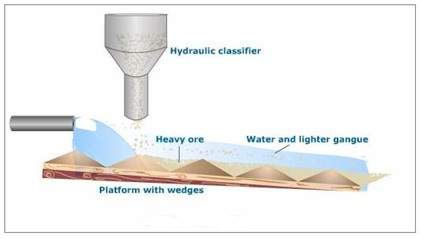
This method is based on the difference in densities of the ore and the gangue particles. The ore particles are washed with streams of water. The lighter gangue particles are washed away with the stream. The heavier or denser ore particles remain behind and can be collected. This method is used for the concentration of heavy oxide ores of lead, tin, iron etc.
(b) Magnetic separation
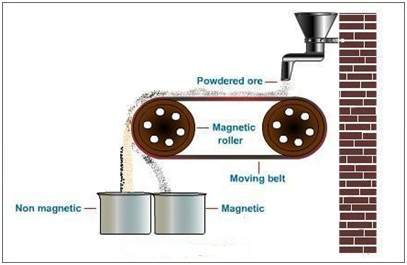
This method of concentration can be applied when the gangue and the ore particles have different magnetic properties. The powdered ore is dropped over a conveyor belt. One of the rollers of the belt is magnetic. The magnetic roller makes the magnetic ore particles stick on the belt and this fall further away. The gangue particles, being non-magnetic, do not stick to the roller and fall first. This method is used for the concentration of iron ores like magnetite, chromite and manganese ore like pyrolusite.
c) Froth flotation process
This process is used for sulfide ores. Sulfide ores are first ground to powder, then water and pine oil is added. The mixture is agitated with air. Oil wets the mineral particles and not the gangue. Oil and froth float on the surface along with the sulfide ore. The gangue particles being insoluble in oil remain at the bottom of the water tank. The froth is skimmed off. This process is used for sulfide ores of Cu, Pb and Zn.

Q.2) Explain the process of roasting with reference to copper.
Answer:
Roasting:
Roasting is one of the steps of the processing of ores. In roasting, the oar or ore concentrate is treated with very hot air at a temperature below their melting point. For example, copper pyrite (CuFeS2) is strongly heated in excess of air to convert it into a mixture of cuprous sulphide (Cu2S) and ferrous sulphide (FeS). And the impurities react with oxygen to form volatile oxides.
2CuFeS2 + O2 → Cu2S + 2FeS + SO2
The gaseous product of sulfide roasting, sulfur dioxide (SO2) is often used to produce sulfuric acid.
Q.3) Write a detailed note on. Ammonia Solvay’s process.
Answer:
Solvay process
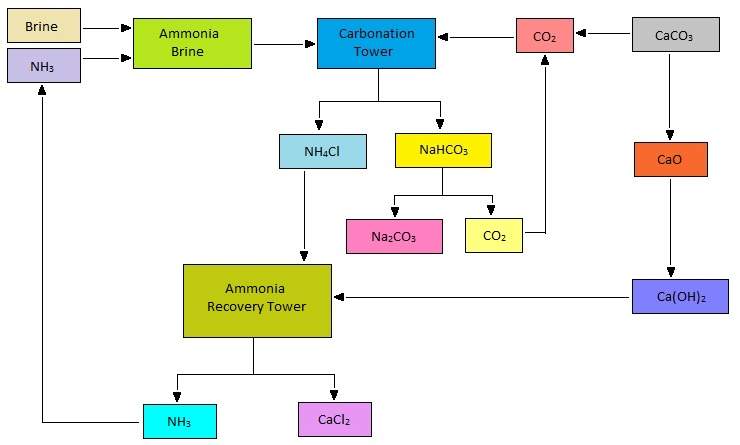
The Solvay process is used to manufacture sodium carbonate (soda ash). Sodium carbonate is one of the most important inorganic chemicals. It is used to manufacture glass, soaps, detergents, paper etc.
Solvay process consists of the following steps
(i) Preparation of ammoniacal brine
Ammonia is dissolved in brine (sodium chloride solution) to form ammonical brine.
(ii) Carbonation
Ammonical brine is fed into a carbonating tower and carbon dioxide is passed through it. Following reactions take place:
CO2 + NH3 + H2O → NH4HCO3
NH4HCO3 + NaCl (brine) → NaHCO3 + NH4Cl
The temperature of the lower compartment is lowered to 15oC and sodium hydrogen carbonate precipitates out.
(iii) Filtration
Precipitates of NaHCO3 are separated from the milky solution. It is used as a baking soda.
(iv) Calcination
Sodium carbonate is produced by heating sodium hydrogen carbonate.

CO2 released is recycled in the process.
(v) Preparation of carbon dioxide and slaked lime
Limestone is heated in a kiln to produce carbon dioxide.

Carbon dioxide is fed into the carbonating tower. Lime (CaO) is mixed with water to produce slaked lime Ca(OH)2.
CaO + H2O → Ca(OH)2
(vi) Recovery of ammonia
Slaked lime is pumped to the ammonia recovery tower and is heated with a solution containing ammonium chloride produced in the carbonation tower.
2NH4Cl + Ca(OH)2 → 2NH3 + CaCl2 + 2H2O
Almost all the ammonia is recovered in this process and is reused in the process.
Q.4) Write a note on fractional distillation of petroleum.
Answer:
Fractional distillation of petroleum
Fractional distillation is the most important step in the refining of petroleum. It is the conversion of crude oil into useful products (fractions) such as liquefied petroleum gas (LPG), gasoline or petrol, kerosene, jet fuel, diesel oil and fuel oils. The various components of crude oil have different sizes, weights and boiling temperatures. So, the principle of fractional distillation is based upon the separation of substances depending upon their boiling points. The substance having the lowest boiling point boils out first leaving the rest behind. Then the next fraction having a slightly higher boiling point boils out. This process continues until a residue is left behind.
Petroleum is refined by fractional distillation in a tall fractionating tower. The crude oil is heated up to 400oC under high pressure in a furnace. Then vapours are passed through a fractional distillation column from near its bottom. Hot vapours rise through the column and gradually they condense according to their boiling points into various fractions. Such that vapours of higher boiling point fractions condense first near the bottom, while vapours of lower boiling point fractions condense last near the top. The vapours of each fraction are collected and condensed separately. In this way, crude oil is separated into various fractions e.g. petroleum gas, petroleum ether, gasoline, kerosene oil, diesel oil, and fuel oil. Each fraction has different physical properties and uses.

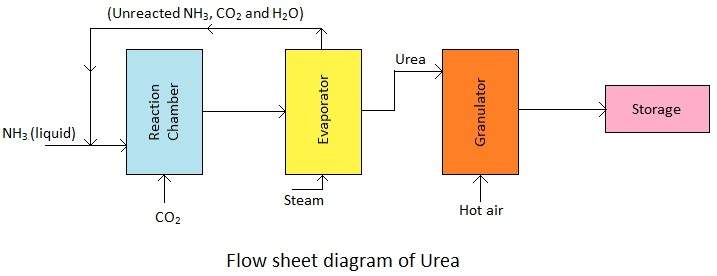
Q.5) How urea is manufactured? Explain showing the flow sheet diagram.
Answer:
Manufacture of urea
Urea is the world’s most commonly used nitrogen fertilizer. It contains 46.6% nitrogen.
Raw materials
The raw materials for the manufacture of urea are:
(i) Ammonia (NH3)
(ii) Carbon dioxide (CO2)
Ammonia is prepared by the Haber process. The Haber process combines 1 volume of nitrogen from the air with 3 volumes of hydrogen derived mainly from natural gas (methane) into ammonia using iron catalyst at 450oC and 200 atm pressure. The reaction is reversible and the production of ammonia is exothermic.

The reaction of ammonia and carbon dioxide
NH3 and CO2 react to form ammonium carbamate.
2NH3 + CO2 → NH2COONH4
Urea formation
When ammonium carbamate is evaporated, it dehydrates and forms urea.
NH2COONH4 → NH2CONH2 + H2O
Granulation of urea
Liquid urea is evaporated to produce granules. This process is done by spraying liquid urea from the top of the tower under pressure and introducing a hot current of air from the bottom. It evaporates to form granules. The granules are packed and then marketed.
Q.6) How crude oil is refined? Explain two important fractions of petroleum along with their usage.
Answer:
Refining of crude oil is its conversion into useful products such as liquefied petroleum gas (LPG), gasoline or petrol, kerosene, jet fuel, diesel oil and fuel oils. These useful products are called fractions. It is carried out by a process called fractional distillation.
Important fractions of petroleum
(i) Petroleum gas
The number of carbon atoms per molecule in petroleum gas ranges from 1 to 4. Its boiling point is up to 25oC. It is used as fuel, as such in the form of LPG. It is also used for the production of carbon black, which is needed in the tyre industry, and hydrogen gas, which is required to form NH3 used to manufacture fertilizer.
(ii) Gasoline
The number of carbon atoms per molecule in gasoline ranges from 7 to 10. Its boiling point ranges from 80 to 170oC. It is used as fuel in motor cars, motorcycles, and other light vehicles. It is used for dry cleaning and is more volatile than kerosene.
Q.7) Write a note in detail on smelting and mesmerization,vapours, giving a specific Example.
Answer:
Smelting
Smelting is a method used to produce a base metal, either as an element or compound, from its ore. This includes the production of silver, iron, copper and other base metals from their ores. Metal ions are heated beyond the melting point with coke and sand in the presence of excess air in a blast furnace. The carbon removes oxygen from the ore, leaving behind the elemental metal. This is a highly exothermic process; therefore, a small amount of coke is required in the process.
For example, ferrous sulphide (FeS) oxidizes to form ferrous oxide (FeO), which reacts with sand (SiO2) to produce iron silicate slag (FeSiO3). The silicate slag is light in weight and rises to the top, so it is removed from the upper hole.
2FeS + 3O2 → 2FeO + 2SO2
FeO + SiO2 → FeSiO3
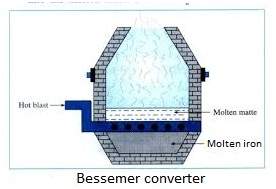
The
Bessemerization
It is the further heating of the molten matte in a Bessemer converter. For example, in this process, hot air is blown through the molten iron matte mixed with sand. Any remaining iron sulphide is oxidized to ferrous oxide. Ferrous oxide then reacts with the sand to form slag which is then removed.
2FeS + 3O2 → 2FeO + 2SO2
FeO + SiO2 → FeSiO3
Chemical Industries Punjab Unit 16 Pdf Download


